单头注意力机制
Q, K, V的理解。
假设Q由如下矩阵组成(不考虑batchsize):
Q[0]:词1:[dim1, dim2, dim3…]
Q[1]:词2:[dim1, dim2, dim3…]
同理K:
K[0]:词1:[dim1, dim2, dim3…]
K[1]:词2:[dim1, dim2, dim3…]
同理V:
V[0]:词1:[dim1, dim2, dim3…]
V[1]:词2:[dim1, dim2, dim3…]
那么Q @ V.T 就是在该词的叉乘和。即计算该词的特征。如果是K的第一行和V的第一列。那么就是计算自己的特征。如果是V的第i列则是计算第一个词和第i个词之间的特征。
Q @ K的结果矩阵:
QK[0]:词1:[词1, 词2, 词3…]
QK[1]:词2:[词1, 词2, 词3…]
此时再 @ V就是对所有词总和一下。QK[0,:] * K[:,0] = 词1*词1+词2*词2…
Softmax计算
直观例子
假设 batch_size=1、num_heads=1、seq_len=3,qk 矩阵如下:
qk = [
    [1.0, 0.5, 0.2],  # 第1个查询对3个键的分数
    [0.3, 1.2, 0.8],  # 第2个查询对3个键的分数
    [0.7, 0.1, 1.5]   # 第3个查询对3个键的分数
]
执行 softmax(dim=-1) 后:
softmax_qk = [
    [0.50, 0.30, 0.20],  # 第1个查询的权重分配
    [0.15, 0.50, 0.35],  # 第2个查询的权重分配
    [0.30, 0.15, 0.55]   # 第3个查询的权重分配
]
每一行的和为 1,符合注意力权重的定义。
维度解释
torch.softmax官方的解释:
参数
dim(int)– 计算 Softmax 的维度(因此 dim 上每个切片的总和为 1)。
Question:-1不是最后一维吗?在矩阵中最后一维不就是列吗?不是对这一列计算让这一列加和为1吗?
假设有一个矩阵(2D张量):
A = [
    [a, b, c],  # 第1行
    [d, e, f]   # 第2行
]最后一维(dim=-1)是“列”:a, b, c 是第一行的3个列元素。确实是对每一行的所有列计算了softmax。
A[0][0]=a, A[0][1]=b, A[0][2]=c.我们一般是想对最后一维softmax,也就是A[0][0-3]计算。那就其实是如题意一样。torch.softmax(A, dim=-1)就行。
代码实现
class SelfAttention(nn.Module):
    def __init__(self, hidden_size,):
        super().__init__()
        self.Q=nn.Linear(hidden_size, hidden_size)
        self.K=nn.Linear(hidden_size, hidden_size)
        self.V=nn.Linear(hidden_size, hidden_size)
        self.linear=nn.Linear(hidden_size, hidden_size)
    def forward(self, x, causal_mask=None, pad_mask=None):
        bs, hd = x.shape[0], x.shape[2]
        q=self.Q(x)
        k=self.K(x)
        v=self.V(x) # (bs, len, dim)

        # (len, dim) @ (dim, len) = (len, len)
        qk = q @ k.transpose(-1, -2) / (hd**0.5)

        if causal_mask:
            qk = qk * causal_mask
        if pad_mask:
            qk = qk * pad_mask

        qk = torch.softmax(qk, dim=-1)

        res = qk @ v

        res=self.linear(res)

        return res


x=torch.rand(2, 192, 64)
# print(x.transpose(-1, -2).shape)
model=SelfAttention(64 )
res=model(x)
res.shape
多头注意力
- 这里要注意计算的时候shape是
(batch_size, nums_head, seq_len, dim)而不是(batch_size, seq_len, nums_head, dim)就行
代码实现
class MultiHeadCrossAttention(nn.Module):
    def __init__(self, hidden_size, head_nums):
        super().__init__()
        self.Q=nn.Linear(hidden_size, hidden_size)
        self.K=nn.Linear(hidden_size, hidden_size)
        self.V=nn.Linear(hidden_size, hidden_size)
        self.linear=nn.Linear(hidden_size, hidden_size)
        self.head_nums=head_nums
    def forward(self, q, key_value, causal_mask=None, pad_mask=None):
        (bs, N, hd) = q.shape
        hd/=self.head_nums
        q=self.Q(q)
        k=self.K(key_value)
        v=self.V(key_value) # (bs, len, dim)

        # (bs, len, head_nums, dim/head_nums) -> (bs,head_nums,len,dim/head_nums)
        q=q.reshape(bs, N, self.head_nums, -1).transpose(1,2)
        k=k.reshape(bs, N, self.head_nums, -1).transpose(1,2)
        v=v.reshape(bs, N, self.head_nums, -1).transpose(1,2)

        # (len, dim) @ (dim, len) = (len, len)
        qk = q @ k.transpose(-1, -2) / (hd**0.5)

        if causal_mask:
            qk = qk * causal_mask
        if pad_mask:
            qk = qk * pad_mask

        qk = torch.softmax(qk, dim=-1)

        res = qk @ v  #(bs,head_nums,len,dim/head_nums)
        res = res.transpose(1,2).reshape(bs, N, -1)

        res=self.linear(res)

        return res

class MultiHeadSelfAttention(nn.Module):
    def __init__(self, hidden_size, head_nums):
        super().__init__()
        self.head_nums=head_nums
        self.hidden_size=hidden_size
        self.Q=nn.Linear(hidden_size, hidden_size)
        self.K=nn.Linear(hidden_size, hidden_size)
        self.V=nn.Linear(hidden_size, hidden_size)
        self.linear=nn.Linear(hidden_size, hidden_size)
    def forward(self, x, causal_mask=None, pad_mask=None):
        (bs, N, hd) = x.shape
        q=self.Q(x)
        k=self.K(x)
        v=self.V(x) # (bs, len, dim)
        hd/=self.head_nums
        q=q.reshape(bs, N, self.head_nums, -1).transpose(1,2)
        k=k.reshape(bs, N, self.head_nums, -1).transpose(1,2)
        v=v.reshape(bs, N, self.head_nums, -1).transpose(1,2)

        # (len, dim) @ (dim, len) = (len, len)
        qk = q @ k.transpose(-1, -2) / (hd**0.5)

        if causal_mask:
            qk = qk * causal_mask
        if pad_mask:
            qk = qk * pad_mask

        qk = torch.softmax(qk, dim=-1)

        res = qk @ v
        res = res.transpose(1,2).reshape(bs, N, -1)

        res=self.linear(res)

        return res


if __name__=='__main__':
    '''
    multi-head attention
    '''
    q=torch.rand(2, 192, 64)
    encoder_output=torch.rand(2, 192, 64)
    # print(x.transpose(-1, -2).shape)
    model=MultiHeadCrossAttention(64, 8)
    res=model(q, encoder_output)
    print(res.shape)

    '''
    self-attention
    '''
    x=torch.rand(2, 192, 64)
    # print(x.transpose(-1, -2).shape)
    model=MultiHeadSelfAttention(64, 8)
    res=model(x)
    print(res.shape)
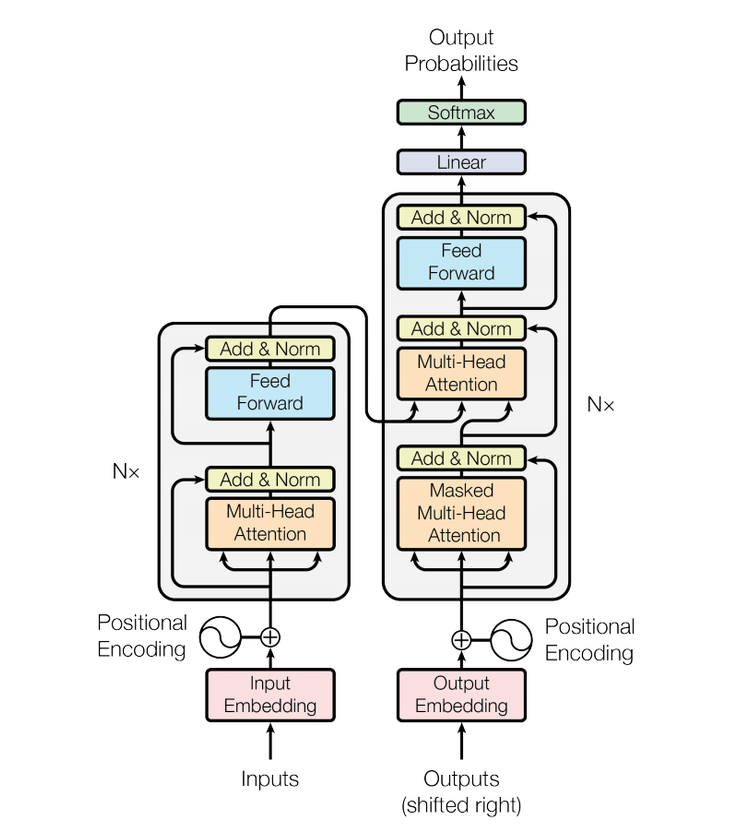
Tranformer Encoder
Position Embedding & Token Embedding
传统位置编码:
$$ \mathbf{PE}{(pos, 2i)} = \sin\left(\frac{pos}{10000^{\frac{2i}{d{\text{model}}}}}\right) $$
其中,$- pos$ 表示位置索引。 $- i$ 表示维度索引。 $- d_model$ 表示嵌入维度的大小。
from torch import nn
import torch
import math
from transformers import AutoTokenizer, AutoModelForMaskedLM


class TokenEmbedding(nn.Module):
    def __init__(self, vocab_size, hidden_size):
        super().__init__()
        self.embedding = nn.Embedding(vocab_size, hidden_size)  # 嵌入层

    def forward(self, x):
        # x 形状: (batch_size, seq_len)
        embedded = self.embedding(x)  # 嵌入后的形状: (batch_size, seq_len, hidden_size)
        return embedded

class PositionalEmbedding(nn.Module):
    def __init__(self, max_len, hidden_size):
        super().__init__()
        self.hidden_size = hidden_size

        # 创建位置编码表,大小为 (max_len, hidden_size)
        # position: (max_len, 1),表示序列中的位置索引,例如 [[0.], [1.], [2.], ...]
        position = torch.arange(0, max_len).unsqueeze(1).float()

        # div_term: (hidden_size / 2),用于计算位置编码的分母
        div_term = torch.exp(torch.arange(0, hidden_size, 2).float() * (-math.log(10000.0) / hidden_size))

        # 初始化位置编码矩阵 pe 为零矩阵,大小为 (max_len, hidden_size)
        pe = torch.zeros(max_len, hidden_size)

        # 计算位置编码矩阵,广播机制将 dive_term 扩展为 (1, hidden_size )
        # 偶数索引列使用 sin 函数
        pe[:, 0::2] = torch.sin(position * div_term)
        # 奇数索引列使用 cos 函数
        pe[:, 1::2] = torch.cos(position * div_term)

        # 将位置编码矩阵注册为 buffer,模型训练时不会更新它
        self.register_buffer('pe', pe)

    def forward(self, x):
        # x 的形状: (batch_size, seq_len, hidden_size)
        seq_len = x.size(1)

        # 将位置编码加到输入张量上
        # self.pe[:seq_len, :] 的形状为 (seq_len, hidden_size)
        # unsqueeze(0) 使其形状变为 (1, seq_len, hidden_size),便于与输入张量相加
        x = x + self.pe[:seq_len, :].unsqueeze(0)

        # 返回加上位置编码后的张量
        return x


if __name__ == "__main__":
    # 1) 取一个真正大模型的词表(BERT base)
    # Load model directly
    tokenizer = AutoTokenizer.from_pretrained("google-bert/bert-base-uncased")
    # model = AutoModelForMaskedLM.from_pretrained("google-bert/bert-base-uncased")

    vocab_size = tokenizer.vocab_size          # 30522
    hidden_size = 768                          # 跟 bert-base-uncased 一致

    # 2) 实例化自定义的 TokenEmbedding
    model = TokenEmbedding(vocab_size, hidden_size)

    # 3) 准备若干句子
    sentences = [
        "Transformers are amazing!",
        "Let's test our token embedding layer."
    ]

    # 4) 使用 tokenizer 转成 token ids;同时统一 sequence length(padding)
    encoded = tokenizer(
        sentences,
        padding=True,
        truncation=True,
        return_tensors="pt"
    )

    input_ids = encoded["input_ids"]           # shape: (batch_size, seq_len)

    print("Token IDs:\n", input_ids)
    print("Shape:", input_ids.shape)

    # 5) 喂进嵌入层
    with torch.no_grad():
        embedded = model(input_ids)            # (batch_size, seq_len, hidden_size)

    print("Embedded Tensor Shape:", embedded.shape, '\n')

    embedding_table = model.embedding.weight           # (vocab_size, hidden_size)

    # -------- 从 embedded 反推出 token id --------------
    # 把 (batch, seq_len, hidden) 拉平成 (batch*seq_len, hidden)
    flat_emb = embedded.view(-1, hidden_size)          # (B*S, H)

    # 点积得到相似度,越大越相似
    sim = torch.matmul(flat_emb, embedding_table.t())  # (B*S, V)
    print('embedding_table.shape:', embedding_table.shape)

    # 对 vocab 维度取 argmax 得到最相似的 token id
    pred_ids = torch.argmax(sim, dim=-1)               # (B*S, )

    # reshape 回原来的 (batch, seq_len)
    pred_ids = pred_ids.view(embedded.size(0), embedded.size(1))

    print("\nRecovered ids:")
    print(pred_ids)

    # -------- 2. 解码成字符串 -----------------------------
    decoded_text = tokenizer.batch_decode(
        pred_ids,
        skip_special_tokens=False,    # 为了对照,先不去掉 [PAD]/[CLS]/[SEP]
        clean_up_tokenization_spaces=True
    )

    print('original text')
    print(sentences)

    print("\nDecoded text:")
    for i, sent in enumerate(decoded_text):
        print(f"{i}: {sent}")


    pos_emb_model = PositionalEmbedding(vocab_size, hidden_size)
    pos_emb_embedded = pos_emb_model(embedded)
    print('\npos_emb_embedded.shape:', pos_emb_embedded.shape)
Encoder Layer
class EncoderLayer(nn.Module):
    def __init__(self, hidden_size, num_heads, ff_size, dropout_prob=0.1):
        super().__init__()
        self.multi_head_attention = MultiHeadSelfAttention(hidden_size, num_heads)  # 多头注意力层
        self.dropout1 = nn.Dropout(dropout_prob)  # Dropout 层
        self.layer_norm1 = nn.LayerNorm(hidden_size)  # LayerNorm 层

        self.feed_forward = nn.Sequential(
            nn.Linear(hidden_size, ff_size),  # 前馈层1
            nn.ReLU(),  # 激活函数
            nn.Linear(ff_size, hidden_size)  # 前馈层2
        )
        self.dropout2 = nn.Dropout(dropout_prob)  # Dropout 层
        self.layer_norm2 = nn.LayerNorm(hidden_size)  # LayerNorm 层

    def forward(self, x, attention_mask=None):
        # 多头注意力子层
        attn_output = self.multi_head_attention(x, attention_mask)  # (batch_size, seq_len, hidden_size)
        attn_output = self.dropout1(attn_output)  # Dropout
        out1 = self.layer_norm1(x + attn_output)  # 残差连接 + LayerNorm

        # 前馈神经网络子层
        ff_output = self.feed_forward(out1)  # (batch_size, seq_len, hidden_size)
        ff_output = self.dropout2(ff_output)  # Dropout
        out2 = self.layer_norm2(out1 + ff_output)  # 残差连接 + LayerNorm

        return out2

x=torch.rand(2, 192, 64)
model=EncoderLayer(64, 8, 32)
model(x).shape
Transformer Decoder
Transformer的Decoder层与Encoder大体类似,除了包含多头自注意力机制和前馈神经网络,还增加了一个用于编码器-解码器注意力机制的多头注意力子层。这使得 Decoder 层能够同时关注当前输出序列的上下文信息和输入序列的编码信息。
CrossAttention
import torch.nn as nn
import torch
class MultiHeadCrossAttention(nn.Module):
    def __init__(self, hidden_size, head_nums):
        super().__init__()
        self.Q=nn.Linear(hidden_size, hidden_size)
        self.K=nn.Linear(hidden_size, hidden_size)
        self.V=nn.Linear(hidden_size, hidden_size)
        self.linear=nn.Linear(hidden_size, hidden_size)
        self.head_nums=head_nums
    def forward(self, q, key_value, causal_mask=None, pad_mask=None):
        (bs, N, hd) = q.shape
        hd/=self.head_nums
        q=self.Q(q)
        k=self.K(key_value)
        v=self.V(key_value) # (bs, len, dim)

        # (bs, len, head_nums, dim/head_nums) -> (bs,head_nums,len,dim/head_nums)
        q=q.reshape(bs, N, self.head_nums, -1).transpose(1,2)
        k=q.reshape(bs, N, self.head_nums, -1).transpose(1,2)
        v=q.reshape(bs, N, self.head_nums, -1).transpose(1,2)

        # (len, dim) @ (dim, len) = (len, len)
        qk = q @ k.transpose(-1, -2) / (hd**0.5)

        if causal_mask:
            qk = qk * causal_mask
        if pad_mask:
            qk = qk * pad_mask

        qk = torch.softmax(qk, dim=-1)

        res = qk @ v  #(bs,head_nums,len,dim/head_nums)
        res = res.transpose(1,2).reshape(bs, N, -1)

        res=self.linear(res)

        return res


q=torch.rand(2, 192, 64)
encoder_output=torch.rand(2, 192, 64)
# print(x.transpose(-1, -2).shape)
model=MultiHeadCrossAttention(64, 8)
res=model(q, encoder_output)
res.shape
Decoder Layer
class DecoderLayer(nn.Module):
    def __init__(self, hidden_size, num_heads, ff_size, dropout_prob=0.1):
        super().__init__()
        self.multi_head_attention = MultiHeadSelfAttention(hidden_size, num_heads)  # 多头注意力层
        self.dropout1 = nn.Dropout(dropout_prob)  # Dropout 层
        self.layer_norm1 = nn.LayerNorm(hidden_size)  # LayerNorm 层

        self.multi_head_attention2 = MultiHeadCrossAttention(hidden_size, num_heads)  # 多头注意力层
        self.dropout2 = nn.Dropout(dropout_prob)  # Dropout 层
        self.layer_norm2 = nn.LayerNorm(hidden_size)  # LayerNorm 层

        self.feed_forward = nn.Sequential(
            nn.Linear(hidden_size, ff_size),  # 前馈层1
            nn.ReLU(),  # 激活函数
            nn.Linear(ff_size, hidden_size)  # 前馈层2
        )
        self.dropout3 = nn.Dropout(dropout_prob)  # Dropout 层
        self.layer_norm3 = nn.LayerNorm(hidden_size)  # LayerNorm 层

    def forward(self, x, encoder_output, attention_mask=None):
        # 多头注意力子层
        attn_output = self.multi_head_attention(x, attention_mask)  # (batch_size, seq_len, hidden_size)
        attn_output = self.dropout1(attn_output)  # Dropout
        out1 = self.layer_norm1(x + attn_output)  # 残差连接 + LayerNorm

        cross_out=self.multi_head_attention2(out1, encoder_output)
        cross_attn_output = self.dropout1(cross_out)  # Dropout
        out2 = self.layer_norm2(out1 + cross_attn_output)  # 残差连接 + LayerNorm

        # 前馈神经网络子层
        ff_output = self.feed_forward(out2)  # (batch_size, seq_len, hidden_size)
        ff_output = self.dropout2(ff_output)  # Dropout
        out3 = self.layer_norm3(out2 + ff_output)  # 残差连接 + LayerNorm

        return out2

x=torch.rand(2, 192, 64)
encoder_output=torch.rand(2, 192, 64)
model=DecoderLayer(64, 8, 32)
model(x, encoder_output).shape